How to Run a Software Free Trial That Actually Tells You Something
Free trials are usually wasted on clicking around. A day-by-day plan for a 14-day trial: define success, test with real work and real people, check the boring stuff, and decide on evidence.
Key takeaways
- Write down what 'success' means before the trial starts — three measurable criteria.
- Test with real work and the real people who'll use the tool daily.
- Check the boring essentials during the trial: export, permissions, support response and billing terms.
- Cancel or decide before the trial converts — put the end date in your calendar on day one.
Free trials should be the best part of buying software: you get to see the tool on your own work before paying. In reality, most trials are spent clicking through features in the first two days and then forgetting about the tool until a charge appears on the card.
Here's a structured approach that turns a trial into a reliable decision.
Before the trial: decide what success looks like
Write down three specific success criteria. For example:
- "Sales reps log every call within the CRM without reminders."
- "We answer support emails in under four business hours using the help desk."
- "Month-end reconciliation takes under two hours."
Also decide:
- Who will test — the people who will use it daily, not only the person buying it.
- What real work will go through the tool during the trial.
- What you'll compare against — your current process or another tool's trial.
Put the trial end date in your calendar on day one, with a reminder two days before.
The 14-day plan
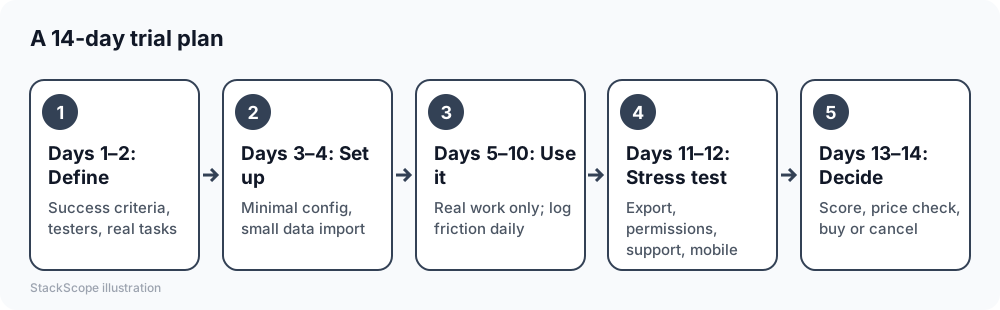
Days 1–2: Define and prepare
Share the success criteria with testers. Choose a small slice of real work: one project, one sales rep's pipeline, one week of support email.
Days 3–4: Minimal setup
Resist the urge to configure everything. Set up only what's needed for the real work: users, a few fields or templates, one integration that matters. Import a small, clean sample of data, not your entire history.
If setup takes more than a day for a simple tool, note it — it's a signal about ongoing complexity.
Days 5–10: Use it for real work
This is the heart of the trial. Testers do their actual job in the tool and keep a short daily log:
- What took longer than expected?
- What did they work around?
- What did they like?
Hold a 15-minute check-in on day 7 to fix blockers quickly.
Days 11–12: Test the boring essentials
These rarely appear in demos but often decide long-term happiness:
- Export: export your data and open it. Is it complete and usable?
- Permissions: can you limit what different roles see and do?
- Offboarding: remove a test user — what happens to their data?
- Support: ask a real question and time the response
- Mobile: do the key tasks work on a phone?
- Security: MFA, SSO options, audit logs, data location
- Integrations: does the one integration you rely on work as advertised?
- Billing: plan limits, overages, renewal and cancellation terms
Days 13–14: Score and decide
Score the tool against your success criteria and ask testers one blunt question: "Would you be disappointed if we didn't buy this?" Lukewarm answers predict poor adoption.
Then check the price for the plan you actually need — including features you discovered you require during the trial — and read the key contract terms. See our SaaS contract red flags.
Comparing two tools fairly
If you trial two tools:
- Run them at the same time with the same tasks.
- Give each the same setup effort.
- Score them independently, then compare.
- Beware the first-tool advantage — people tend to prefer whatever they learned first. A blind comparison of outputs helps where possible.
Ask for more time — or a pilot
If the trial period is too short for your cycle (for example, monthly processes), ask the vendor for an extension. Many will agree, especially for team plans. For larger purchases, propose a paid pilot for one or two months with a clear decision date.
Red flags during a trial
- Key features you saw in a demo are only available on a much higher tier.
- Support doesn't respond during the trial — it rarely improves after you pay.
- You can't export your data easily.
- Testers quietly go back to the old way within a few days.
- Pressure to sign an annual contract before the trial ends.
After you decide
If you buy: document the setup decisions you made, keep your success criteria and review them after 60–90 days.
If you don't: cancel before conversion, delete your data if it contains anything sensitive, and note why — it'll save time next time.
Worked example: choosing a field-service app
Consider a hypothetical HVAC company trialing two field-service apps to replace paper job sheets.
Criteria. Technicians can complete a job sheet with photos and a customer signature in under five minutes; the office can schedule tomorrow's jobs in under thirty minutes; and invoices sync to the accounting system without re-typing.
Trial. Two technicians and the office coordinator use both apps on real jobs for ten days, logging friction daily.
Findings. App A looks better in the demo, but its offline mode fails in basements without signal. App B is plainer but works offline and syncs cleanly. App A's support takes three days to reply to a test question; App B's replies within hours. App B's export includes complete job history.
Decision. App B wins clearly on the criteria, and the technicians — asked whether they'd be disappointed to lose it — say yes. The company signs a monthly plan for the first quarter before committing to an annual contract.
Frequently asked questions
Should we enter a credit card for a trial? Only if you've set a reminder to cancel. Where possible, choose trials that don't require payment details.
How many tools should we trial? Usually two, at most three. More than that and nobody uses any of them properly.
What if the vendor offers a big discount to sign during the trial? Discounts tied to deadlines are a sales tactic. If the tool hasn't met your criteria, the discount doesn't matter.
The bottom line
Define success before you start, test with real work and real users, check export, permissions, support and billing during the trial, and decide on evidence before the trial converts. Two focused weeks beat months of regret.