SaaS Contract Red Flags: 9 Clauses to Read Before You Click 'Accept'
Auto-renewals, price increases, data ownership, termination and liability limits. A plain-language guide to the clauses in software agreements that matter most to small businesses.
Key takeaways
- Find the renewal date and notice period before you sign, and put them in your calendar.
- Check how much prices can rise at renewal — and whether you can leave if they do.
- Make sure you can export your data in a usable format and know how long the vendor keeps it after you leave.
- Small businesses can negotiate more than they think, especially on annual contracts.
Most small businesses accept software terms with a click. That's understandable — the documents are long and the tool is needed today. But a few clauses can cost real money or cause real pain later: a renewal you can't cancel, a price that doubles, data you can't get back.
You don't need to read every line. You need to know where to look.
Note: this is general information to help you review agreements, not legal advice. For high-value or high-risk contracts, ask a lawyer to review them.
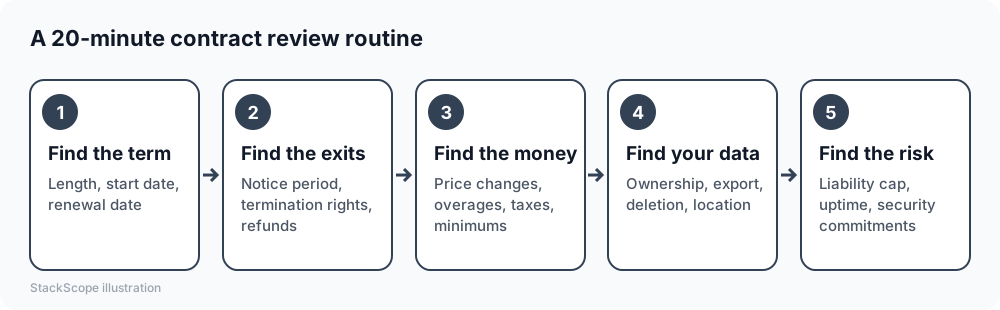
1. Auto-renewal and notice periods
Many SaaS agreements renew automatically for the same term — often a full year — unless you give notice 30, 60 or even 90 days before the end. Miss the window and you're committed for another year.
What to do: note the renewal date and the notice deadline in a shared calendar the day you sign. Ask whether the contract can renew month-to-month after the first term.
2. Price increases at renewal
Look for language allowing the vendor to change prices "upon renewal" or "with notice." Some contracts cap increases; many don't.
What to do: ask for a cap (for example, a fixed percentage) or a multi-year price lock, especially for core tools.
3. Minimum commitments and seat true-ups
Some contracts commit you to a minimum number of seats or a minimum spend for the whole term, and some charge you retroactively ("true-up") if usage exceeds what you bought.
What to do: buy for current needs, confirm whether you can reduce seats at renewal, and understand how overages are billed.
4. Termination rights
Check when you can terminate (for convenience? only for the vendor's breach?) and when they can — sometimes with very short notice. Also check whether prepaid fees are refunded.
What to do: for long contracts, ask for the right to terminate if the vendor materially changes the service or fails to meet its commitments.
5. Data ownership and export
You should own your data. Look for clear statements that customer data belongs to you, and check:
- Export: can you get all your data out, in a standard format, at any time — including during a notice period?
- Post-termination access: how many days do you have after the contract ends?
- Deletion: when and how does the vendor delete your data?
6. Use of your data (including for AI)
Many vendors now add AI features. Read how they use your content: to provide the service only, or also to improve their products and train models? Is it aggregated or anonymized? Can you opt out?
What to do: for sensitive customer data, prefer plans and terms that exclude your data from training, and confirm it in writing.
7. Uptime and support commitments
A service level agreement (SLA) states availability targets and what happens if they're missed — usually service credits, not cash. Many small-business plans have no SLA at all.
What to do: for business-critical tools, ask what the SLA is, how credits are claimed, and what support response times apply to your plan.
8. Limitation of liability
Most vendor contracts cap their liability — commonly at the fees you paid in the previous 12 months — and exclude indirect losses. That's standard, but it means that if the vendor loses your data, compensation may be small.
What to do: accept that this is common, and manage risk yourself with backups and exports. For high-risk services, ask whether data-breach liability has a higher cap.
9. Changes to the terms
Some agreements let the vendor update terms by posting a new version on their website. Look for whether you'll be notified and whether you can terminate if changes harm you.
Data protection terms
If you handle personal data of customers in regions with strong privacy laws (such as the EU or UK), check whether the vendor offers a data processing agreement (DPA), lists its subprocessors, and explains international data transfers. Most reputable vendors publish these on a trust or legal page.
Yes, small businesses can negotiate
Self-serve monthly plans usually aren't negotiable, but annual or sales-led contracts often are. Reasonable asks include:
- A price cap or multi-year price lock
- Monthly renewal after the first year, or a shorter notice period
- Right to reduce seats at renewal
- Extended data export window after termination
- Written confirmation your data won't be used for model training
- Onboarding or training included
Ask politely, in writing, and before you sign — leverage disappears afterwards.
Keep a contract record
For every significant tool, store in one place: the signed agreement or terms version, order form, renewal date, notice period, price and the contact for account changes. Our SaaS budgeting guide shows a simple inventory you can extend.
Worked example: a marketing platform renewal
Imagine a hypothetical retailer that signed an annual contract for a marketing platform. The first year went well, so nobody checked the renewal terms.
The surprise. Ninety days before renewal, the vendor emails a price increase. The contract requires 60 days' notice to cancel, and nothing caps renewal increases.
Response. Because the renewal date was in the team's calendar, they still have a month before the notice deadline. They remove unused seats, gather a quote from an alternative platform, and ask the vendor for a two-year price lock at the previous rate, a reduced notice period and written confirmation of data export rights.
Outcome. The vendor agrees to a smaller increase with a multi-year cap and month-to-month renewal after the term. The retailer adds price caps and notice periods to its standard checklist for every new contract.
Frequently asked questions
Are click-through terms legally binding? Generally yes, in many jurisdictions. Treat "I agree" as signing.
Can a vendor really raise prices mid-contract? It depends on the terms. Many contracts fix prices for the current term but allow changes at renewal. Read the pricing and changes sections.
What if we missed the cancellation window? Ask anyway. Some vendors will agree to a shorter renewal or credit, especially if you're polite and clear that you'll leave at the next opportunity.
The bottom line
Before accepting software terms, find the renewal date and notice period, check price-increase limits, confirm you can export your data and how it's used, understand termination rights, and negotiate what matters on annual contracts. Twenty minutes of reading can prevent a year of regret.